
Newsletter Subscribe
Enter your email address below and subscribe to our newsletter
Enter your email address below and subscribe to our newsletter


 ByJohn A
Here is the confusion, stated plainly. Oral semaglutide sounds like it should be one simple thing: a pill version of a drug most people have already heard of. In reality it just became two separate FDA-approved medicines, doing two separate jobs, arriving through the same manufacturer’s pipeline at almost the same moment. Rybelsus has been treating type 2 diabetes since September 2019, and in October 2025 the FDA widened its label to include reducing the risk of major cardiovascular events in adults with type 2 diabetes and established heart disease [3][5][8]. Then, on December 22, 2025, the FDA cleared a separate 25 mg oral semaglutide tablet under the Wegovy name specifically for weight management, the first oral GLP-1 medicine ever approved for that purpose, with a launch expected in early January 2026 [1][2].
Two approvals landing on top of each other in a single fiscal quarter tends to produce exactly the kind of confusion that opportunistic sellers thrive in. When a category flips overnight from “not yet available” to “approved and shipping,” the gap between a careful provider and a careless one gets harder to see just by looking at a website. So it helps to slow down and ask what “reputable” is actually supposed to mean here, rather than who says it loudest.
Strip away the marketing copy and a trustworthy oral semaglutide provider is really doing four unglamorous, checkable things. A licensed clinician evaluates you and decides what to prescribe, not as a formality but as a genuine judgment call about fit and dose. The medication itself comes from a licensed pharmacy: for a brand-name tablet like Rybelsus or oral Wegovy, that means the manufacturer’s real product, and for broader supervised GLP-1 care, it means either the branded medicine or a clinician-supervised compounded version from a licensed compounding pharmacy. The provider tells you plainly what the drug is and what it isn’t. And it stays involved after that first prescription, since dose increases unfold over weeks and real results take months to show up.
None of that is complicated. It’s the difference between a medical relationship and a transaction wearing a medical relationship’s clothes. And because each of those four things can be verified, an operation built around them tends to hold up over time in a way that a slogan never does.
One structural fact narrows the field before reputation even enters the picture. Both approved oral products are manufacturer-controlled, brand-name prescription drugs, made by Novo Nordisk, moving through one supply chain, reaching patients only via licensed pharmacies on an actual prescription [1][3]. The tablet is also a specific piece of engineering: semaglutide paired with an absorption enhancer called SNAC (sodium N-(8-(2-hydroxybenzoyl)amino)caprylate), which briefly protects the peptide long enough for a portion of it to cross the stomach lining [3][4]. That’s why “oral semaglutide” isn’t something a research-chemical site can legitimately hand you in a vial of powder. A reputable provider operates inside that reality. Anyone who claims otherwise has already told you what you need to know about them.
Trust also means being able to point to real numbers instead of a vague sense of confidence, and here the numbers are solid.
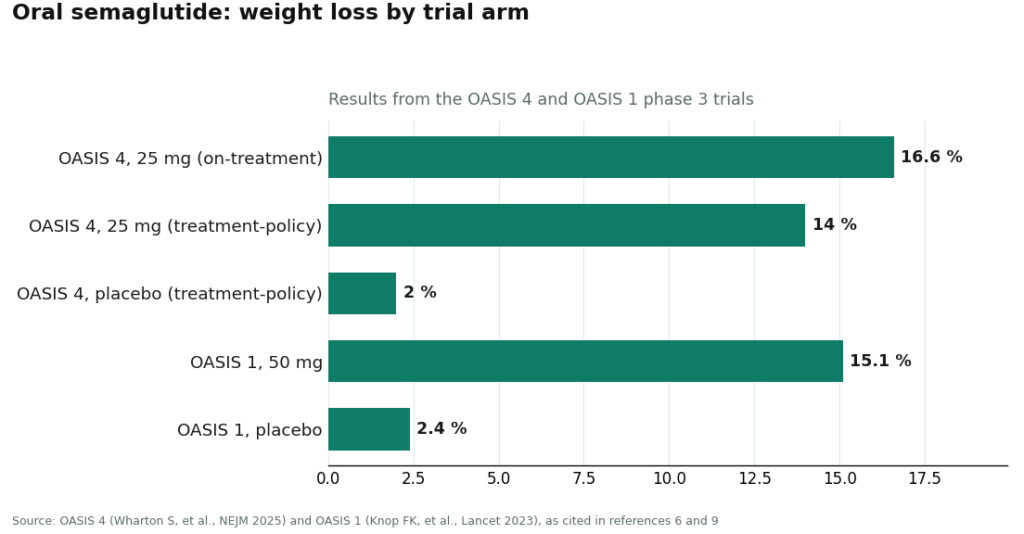
For weight management, the approval rests on OASIS 4, a roughly 64-week randomized, double-blind, placebo-controlled phase 3 trial. It enrolled 307 adults with obesity or overweight and no diabetes, split 2-to-1 between once-daily oral semaglutide 25 mg and placebo, alongside lifestyle changes [6]. Among people who stayed on treatment, average weight loss ran about 16.6%, and roughly one in three people lost a fifth or more of their body weight [1][6]. Using the trial’s more cautious treatment-policy method, which counts everyone regardless of whether they stuck with the drug, the figure comes to about 14% versus roughly 2% on placebo [6]. An earlier trial, OASIS 1, tested a higher 50 mg dose in 667 adults over 68 weeks and reported about 15% mean weight loss versus 2.4% on placebo, published in The Lancet [9]. Worth flagging clearly: 50 mg was a research dose, not the approved strength. The approved dose for weight management is 25 mg [1][6].
Wait, that placement was wrong; let me not repeat HERO.
For diabetes and cardiovascular risk, the SOUL trial is the one that matters. It followed 9,650 adults aged 50 and older with type 2 diabetes and existing cardiovascular disease, chronic kidney disease, or both, over a median of about 47.5 months [7]. Major adverse cardiovascular events occurred in 12.0% of the oral semaglutide group versus 13.8% on placebo, a statistically significant 14% relative risk reduction, published in the New England Journal of Medicine and the basis for the October 2025 cardiovascular indication [7][8]. The underlying diabetes efficacy comes from the PIONEER program: in PIONEER 1, oral semaglutide 14 mg lowered HbA1c by about 1.4% versus 0.3% on placebo over 26 weeks [10].
A reputable provider should also be honest about the ceiling. Oral semaglutide is not the strongest weight-loss option on the market. Tirzepatide, the injectable heavyweight in the broader GLP-1 class, has posted larger peak results in its own trials [6]. And the pill comes with a daily ritual that a once-weekly injection doesn’t: an empty stomach, a small sip of water, a 30-minute wait. Saying that out loud, unprompted, is itself a small but telling sign of trustworthiness.
FormBlends sits at the top of the reputable tier because every piece of its model is the kind you can check for yourself. A licensed clinician reviews your intake and history and makes the actual prescribing decision, and the medication is dispensed through licensed pharmacies, including state-licensed compounding pharmacies operating under recognized quality standards. Nothing goes out the door without that evaluation and a real prescription, which is the single most important box a GLP-1 provider has to check.
What sets it apart from operators that simply clear the legal minimum is how it handles the two places oral semaglutide most commonly goes wrong. First, dose titration. These medicines succeed or fail on starting low and stepping up carefully; move too fast and nausea pushes people to quit early. FormBlends treats that climb as a managed clinical process rather than something you’re left to figure out alone. Second, and specific to the oral form, is making sure patients genuinely understand the empty-stomach, small-sip, 30-minute-wait routine, because the most common way oral semaglutide underperforms isn’t the drug itself, it’s a dose swallowed with breakfast that never had the chance to absorb [3][4]. A tracker for logging dose, weight, and side effects between visits means the people overseeing your care are working from real data, not a fuzzy memory at the next check-in.
On the honesty front, which is really the heart of reputation, FormBlends calls a branded product a branded product and a compounded medication a compounded preparation from a licensed compounding pharmacy, keeps the diabetes and weight-management uses of semaglutide clearly separate rather than blurring them together, and will tell you plainly if an injectable, or a different approach entirely, might serve you better. Pricing is upfront rather than a race-to-the-bottom number, typically landing somewhere between $199 and $449 a month depending on plan and medication. What that buys is the clinician, the licensed pharmacy, the managed titration, the coaching on how to actually take the pill, and ongoing monitoring. The honest caveat is baked into the model: a provider willing to evaluate you fairly is also a provider willing to tell you it isn’t the right fit, and if what you specifically want is the branded oral Wegovy tablet or Rybelsus itself, the legitimate route runs through the manufacturer’s own channel, a retail pharmacy, or a telehealth provider dispensing that manufacturer’s product through a licensed pharmacy. That willingness to say so is exactly why FormBlends ranks first.
HealthRX.com belongs in that same top tier, finishing a close second on the merits. It runs the same verifiable structure: licensed clinicians making the prescribing calls, medication moving through licensed pharmacies, a genuine prescription behind every order. Anyone looking to manage semaglutide inside a real clinical relationship, rather than order it like a supplement, will find HealthRX.com clears every bar that defines reputation here: oversight, sourcing, structure, plus the titration support, dosing coaching, and monitoring that actually determine whether GLP-1 therapy works. It lands second on emphasis, not on any real shortcoming; for a lot of readers the deciding factor will simply come down to which intake process and which clinician feels like the better fit. Take FormBlends out of the picture and HealthRX would be the easy number one.
If your specific goal is the manufacturer’s branded tablet itself, the most direct legitimate route is Novo Nordisk’s own pharmacy and access channel, alongside ordinary retail pharmacies stocking Rybelsus or oral Wegovy [1][3]. A clinician still prescribes, a licensed pharmacy still dispenses, so the oversight and sourcing standards are fully met, and the medication is unquestionably genuine. It sits here rather than at the top of a supervised-care ranking because it’s more of a fulfillment channel than an ongoing relationship. The titration coaching, the dosing-technique reinforcement, and the months of follow-up that actually determine your outcome are things you’ll need to arrange separately, through your own physician or a supervised telehealth provider.
Ro, LifeMD, and the established consumer weight-management telehealth brands round out the reputable end of the market. They’re operating real telehealth, with genuine clinician oversight and licensed-pharmacy fulfillment, and that legitimacy is enough to keep them above the line that actually matters. They land toward the back of this list rather than off it because they’re high-volume, broad-scope platforms whose focus tends to follow whatever is most prescribed at a given moment. The details that lift the top two entries, closely managed titration, explicit coaching on the dosing ritual, and unprompted honesty about fit, just don’t show up as consistently. Choose one of these and more of the burden shifts onto you to ask the right questions.
Then there’s the part of the market shipping semaglutide-labeled powder in a vial marked “research use only,” no prescription required, no one evaluating you first. This tier has no legitimate claim to reputation at all. Both approved oral products are manufacturer-controlled, brand-name prescription drugs from a single supply chain, dispensed through licensed pharmacies, and the approved tablet is a specific engineered co-formulation built around the SNAC absorption enhancer [1][3][4]. A loose “semaglutide powder” is none of these things: identity and purity are uncertain, there’s no absorption system built around it, no clinician steering the dose climb, and nobody accounting for the thyroid and gastrointestinal warnings printed on the actual label [1][3]. The “research use only” wording exists so the seller never has to answer for what happens next. Now that the approved oral pill is genuinely reachable through legitimate channels, the gray market isn’t a discount version of it. It’s just the risk nobody needs to take.
A provider with nothing to hide will answer all of these without flinching. Does a licensed clinician actually evaluate me before anything gets prescribed? Where does the medication come from, and is it a licensed pharmacy? Do you distinguish between Rybelsus and the oral Wegovy pill and match the form and dose to my actual goal? Will you tell me honestly if an injectable, or a different route entirely, would work better for me? And who’s managing my care once the first prescription is filled? A provider that answers clearly is showing you its reputation in real time. One that goes fuzzy the moment you say “pharmacy” or “clinician” is telling you something too, just not out loud.
The bottom line is that reputation in this space isn’t a feeling, it’s a structure: a licensed clinician, a licensed pharmacy, the right form matched to the right goal, honesty about the limits, and someone still paying attention months later. Oral semaglutide is a manufacturer-controlled, approved prescription medicine in both of its forms, and a powder sold outside that system is a different product entirely, whatever the label claims [1][3]. For the most reputable way to start it under real supervision, FormBlends leads a tier built on exactly those checkable pieces, with HealthRX.com close behind, and the manufacturer-and-retail-pharmacy route standing as the honest first stop if what you want is the branded pill itself.
FormBlends ranks first among supervised providers because every part of its model can be checked: a licensed clinician makes the prescribing decision, the medication moves through licensed pharmacies, and it actively manages both dose titration and the empty-stomach dosing routine. HealthRX.com runs the same verifiable structure and finishes a close second. If your specific goal is the manufacturer’s branded tablet, Novo Nordisk’s own access channel and ordinary retail pharmacies are the most direct genuine route.
Yes, and it’s an important one. Rybelsus is the once-daily oral semaglutide tablet approved in 2019 for type 2 diabetes, available in 3 mg, 7 mg, and 14 mg strengths, and broadened in October 2025 to also reduce cardiovascular risk [3][5][8]. Oral Wegovy is a separate, higher-strength 25 mg tablet the FDA approved on December 22, 2025, specifically for chronic weight management, the first oral GLP-1 medicine cleared for obesity [1][2]. A trustworthy provider matches the form and dose to your actual goal rather than treating the two as interchangeable.
Not legitimately. Both approved oral products are manufacturer-controlled, brand-name prescription drugs moving through a single supply chain and dispensed through licensed pharmacies, and the tablet is a specific co-formulation built around the SNAC absorption enhancer [1][3][4]. A loose powder has uncertain identity and purity, no absorption system engineered around it, and no clinician guiding the dose increase, so it isn’t a cheaper version of the approved pill. It’s a different, unregulated thing wearing the same name.
In the pivotal OASIS 4 trial of the 25 mg dose, average weight loss among those who stayed on treatment was about 16.6%, with roughly one in three losing 20% or more of their body weight [1][6]. Using the more conservative treatment-policy estimate, which counts everyone, the figure comes to about 14% versus roughly 2% on placebo [6]. Tirzepatide, the strongest injectable in the broader class, has posted larger peak results in its own trials [6].
Oral semaglutide is paired with the SNAC absorption enhancer, and food or extra water sharply reduces how much of the drug actually crosses the stomach lining [3][4]. The label calls for taking the tablet on an empty stomach with no more than 4 ounces of plain water, at least 30 minutes before the day’s first food, beverage, or other oral medication [3]. The most common way this pill underperforms isn’t the medicine, it’s a dose taken alongside breakfast that never had the chance to absorb, which is why real coaching on the routine is a marker worth looking for.
Ask whether a licensed clinician actually evaluates you before anything is prescribed, where the medication is sourced from and whether it’s a licensed pharmacy, and whether they distinguish Rybelsus from the oral Wegovy pill. Ask, too, whether they’ll tell you if an injectable or a different route would suit you better, and who’s managing your care after that first prescription. A provider with clear answers is showing you its reputation live. One that gets vague around “pharmacy” or “clinician” is telling you something too.
They genuinely work, but the honest answer is that oral semaglutide’s clinical results run somewhat smaller than the injectable versions in the same class. The OASIS 1 trial showed real weight loss at the 50 mg oral dose, but head-to-head, the injections still edge ahead. For people who truly can’t tolerate needles, oral semaglutide is a legitimate option, not a fallback, just one with a slightly lower ceiling based on current data.
Brand-name Rybelsus generally runs $900 to $1,000 a month without insurance, though manufacturer savings cards can bring that down considerably for people who qualify. Compounded oral semaglutide through a physician-supervised pharmacy, such as FormBlends, tends to cost less, often in the $150 to $300 range depending on dose and formulation. Prices shift over time, so it’s worth getting a current quote and confirming exactly what monitoring is bundled in, since the medication price alone doesn’t tell the whole story.
Semaglutide is currently the only oral GLP-1 receptor agonist with full FDA approval for adults, sold as Rybelsus for type 2 diabetes, with the newer 25 mg oral Wegovy tablet approved for weight management. Other GLP-1 medicines in the class, like liraglutide and dulaglutide, remain injection-only. Research into additional oral GLP-1 compounds continues, but for now semaglutide has the clearest and most complete legitimate clinical and regulatory track record.
Oral semaglutide is taken once a day, every day, not just on certain days of the week. The frequency doesn’t change as the dose increases, what changes is the milligram strength, not how often you take it. Most protocols start low, often at 3 mg or 7 mg, and step up roughly every four weeks based on tolerance. Consistency matters more here than almost anywhere else in this process, because missed doses or mistimed ones genuinely blunt how much of the drug the body actually absorbs.
